
Project Description
The Basics of Electronic & Electrical Engineering
This course focuses on the basics of electronics and covers essential theorems.
We are trying to cover as much details as possible to get you up to speed for advanced topics.
Topics to be covered:
- DC Circuit Analysis
- AC Circuit Analysis
- Power & Energy
- Physics of Electronic Devices
- Operational Amplifiers
- Digital Electronics & Microcontrollers
- Signals and Systems
DC Circuit Analysis
Electric Current
Electric current is essentially the movement of electrons. In this post we cover how current is generated, what is EMF and what does it mean to be positively or negatively charged.
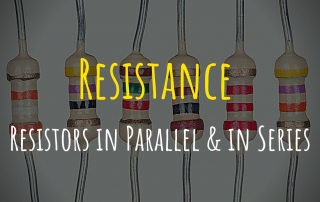
Resistance
To understand resistance, we cover a bit about Potential Difference, Ohm's Law, materials based on conductance, resistors in series and in parallel.

Potential Difference
Potential difference is a voltage compared to a reference point. In this topic we break down how this is related to the EMF, current and load in a circuit.
Power Dissipation
If 6 million million million electrons pass per second, the current is 1A. Today we touch on Power, Electrical Energy and Maximum Power Transfer theory.
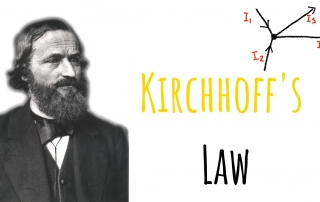
Kirchhoff’s Law
In this topic we cover Kirchhoff's Current and Voltage Law that helps us analyse an electric circuit to find the current, voltage or component values.
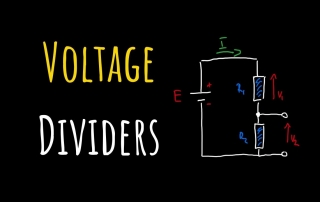
What is a Voltage Divider?
A Voltage Divider is fundamental circuits in electronics. They turn large voltages to smaller ones. Check this topic to see some of the common cases.
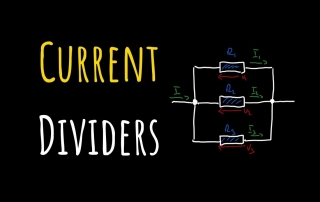
What is a Current Divider?
Based on the resistor values, the current is divided in a parallel circuit. The Current Divider theory helps us to find the current in each split.
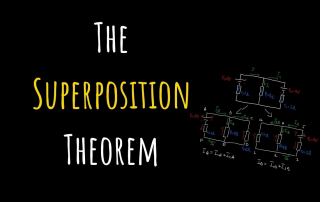
The Superposition Theorem
In this topic we cover how to use the Superposition Theorem in order to solve circuits. We do this by considering only one powers source at a time.
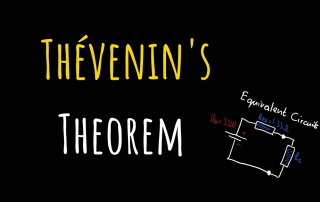
Thévenin’s Theorem
Thévenin's Theorem transforms a complex circuit to its much simplified equivalent consisting of only a single voltage source and a resistor in series.
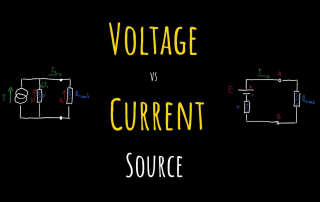
Voltage and Current Source Differences
Voltage and Current Sources are often confusing terms. We cover how they both supply voltage and current, yet they differ in which they are good at.
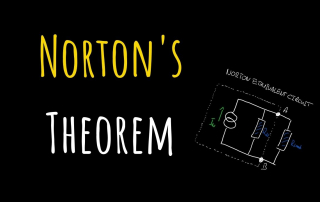
Norton’s Theorem
Norton's Theorem transforms a complex circuit to its much simplified equivalent consisting of only a single current source and a resistor in parallel.
Understanding Input and Output Resistance
The output resistance of one circuit shouldn't always be matched to the input resistance of another. In this topic we discover the various conditions.
Energy & Power
Understanding the Basics of Energy
Energy is the ability to do work. In this topic we investigate the Kinetic as well as the Gravitational Potential Energy with increased object heights.
Energy Generation
Energy generation comes in many forms. Different types of materials contain energy that we turn into fuel. This topic breaks down the various ways.

Renewables: Wind Turbines
Wind Turbines are one of the most common alternatives to fossil fuels. This topic analyses the efficiency as well as derives the formula for power.
Renewables: Solar Power
Photovoltaics is the principle of converting light to electricity. The topic describes the solar power calculation and the idea behind this technology.
Renewables: Hydropower
Hydropower is where the flow of water is converted to electrical energy. This topic covers the various types as well as focuses on energy calculation.

Thermodynamics Made Simple
Thermodynamics consists of a set of laws that characterise a system based on temperature, energy and entropy. When we say 'system', think about a hob..

Transmission Lines & Electricity Distribution
Power Plants generate electricity that is carried to the cities by Transmission Lines. Although, this is is a little complicated due to ohmic losses.
3-Phase Power & Distribution
3-Phase Power is distributed either by a Delta or Star configuration. This topic focuses on the derivation of power, power factor and efficiency.
Induction vs Synchronous Machines
Induction Machines, that always lag behind the synchronous speed, are a simpler from of Synchronous Machines. Let's go into bit more detail about them.
Power Output of Synchronous Machines
About the Synchronous Reactance Model, phasor diagram, leading and lagging power factor in generators/motors due to over/under-excited field current.

Transformers & Equivalent Circuit
Transformers not only step up or down voltages but they are widely used fore they DC blocking capability. Let's dig in and see the working principle.
AC Circuit Analysis
Breakdown of the AC Voltage General Equation
By using a simple wave equation we can characterise a time varying AC voltage signal. In this topic we break down each component with examples.